


4 minute read
Working at height is one of the most hazardous risks in the construction industry, with falls being the leading cause of fatal and severe injuries in the UK. To ensure the safety and protection of all involved, there are legal requirements and guidance in place.
Along with the Health and Safety at Work Act, The Work at Height Regulations 2005 outlines the general duties that employers, employees, and self-employed individuals have towards ensuring health and safety in the workplace, including when working at height.
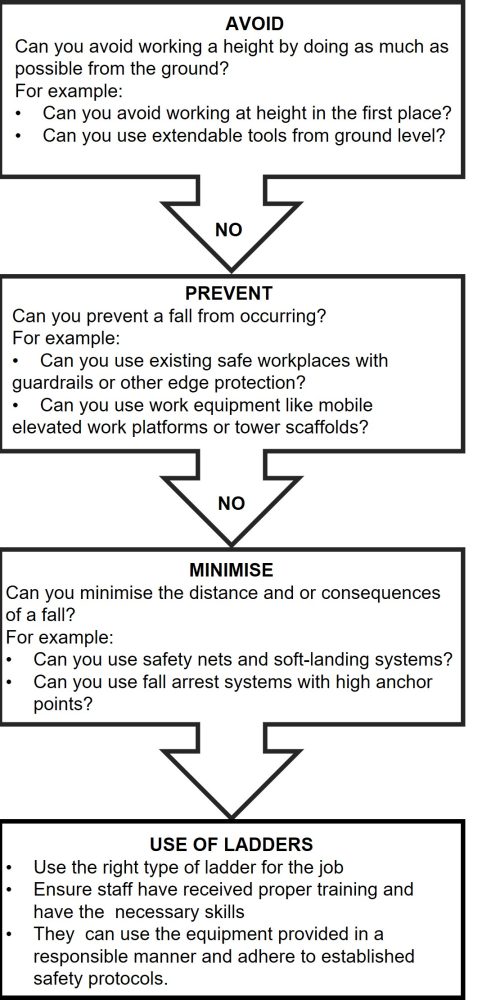
It is important to follow a hierarchy of controls to ensure safety when working at heights, starting with the question of whether the work can be done from the ground. If not, can other safety equipment be considered before resorting to fall restraints or safety netting?
The Health and Safety Executive (HSE) Hierarchy of Controls for working at height step-by-step guide emphasises the priority is to avoid, by eliminating the need for working at height through design and planning. Consider doing as much work as possible from the ground or using extendable tools from ground level.
If it is not possible to avoid working at heigh, you must consider the risk of a person falling from height and put measures in place to prevent an incident.
Use of a Mobile Elevating Work Platforms (MEWPs) scissor lifts, or scaffolding should be considered.
If the risk of a person falling remains, you must take sufficient measures to minimise the distance and/or consequences of a fall.
Using safety nets or fall arrest systems and equipment for working at heights can provide anchorages, harnesses, rescue and evacuation equipment.
Ladders and stepladders can be a practical option for low-risk and short-duration tasks.
To minimize the risk, workers should be trained to effectively use the appropriate ladder for the task at hand.
The working at height regulations apply to employers, employees, and self-employed individuals.
Employer Responsibilities
Employers must follow working at height legal requirements, and health and safety regulations.
Have a comprehensive risk management strategy in place, document, and report any hazards identified.
They are responsible to ensure the safety of their employees and members of the public when working at height.
Provide workers with appropriate training and ensure they are qualified in safe methods of working and supervised where necessary to minimise risks.
They are also responsible for providing and maintaining the necessary equipment for employees when working at height.
Working at height guide aims to provide an understanding of the risks associated with working at height, how to effectively manage them, and comply with the Health and Safety at Work etc. Act 1974.
| Cookie | Duration | Description |
|---|---|---|
| cookielawinfo-checkbox-analytics | 11 months | This cookie is set by GDPR Cookie Consent plugin. The cookie is used to store the user consent for the cookies in the category "Analytics". |
| cookielawinfo-checkbox-functional | 11 months | The cookie is set by GDPR cookie consent to record the user consent for the cookies in the category "Functional". |
| cookielawinfo-checkbox-necessary | 11 months | This cookie is set by GDPR Cookie Consent plugin. The cookies is used to store the user consent for the cookies in the category "Necessary". |
| cookielawinfo-checkbox-others | 11 months | This cookie is set by GDPR Cookie Consent plugin. The cookie is used to store the user consent for the cookies in the category "Other. |
| cookielawinfo-checkbox-performance | 11 months | This cookie is set by GDPR Cookie Consent plugin. The cookie is used to store the user consent for the cookies in the category "Performance". |
| viewed_cookie_policy | 11 months | The cookie is set by the GDPR Cookie Consent plugin and is used to store whether or not user has consented to the use of cookies. It does not store any personal data. |