

4 minute read
Risk Assessments Processes and Procedures
By law, The Management of Health and Safety at Work Regulations 1999 requires organisations to protect employees and others from harm in the workplace.
Risk Assessments form an integral part of an organisations occupational health and safety management plan, they help to:
- Create awareness of hazards and risk
- Identify who may be at risk including employees, visitors and members of the public
- Prevent injuries or illnesses
- Determine if existing control measures are adequate for a particular hazard, or should new controls be implemented
- Meet health & safety and environment legal requirements
- Avoid hefty fines
What is a Risk Assessment?
Risk assessment is the approach to preventing harm and occupational accidents by identifying the hazards that exist or may appear in the workplace.
A risk assessment identifies which workplace hazards are likely to cause harm to employees and visitors and what reasonable measures to put in place to control the risks in your workplace.
Organisations with five or more employees, should have processes and procedures in place to meet the legal requirements, as a minimum:
- A documented health and safety policy
- Documented instruction and training for employees about the risks in your workplace and how they are protected
- Access to competent health and safety advice
Risk Events
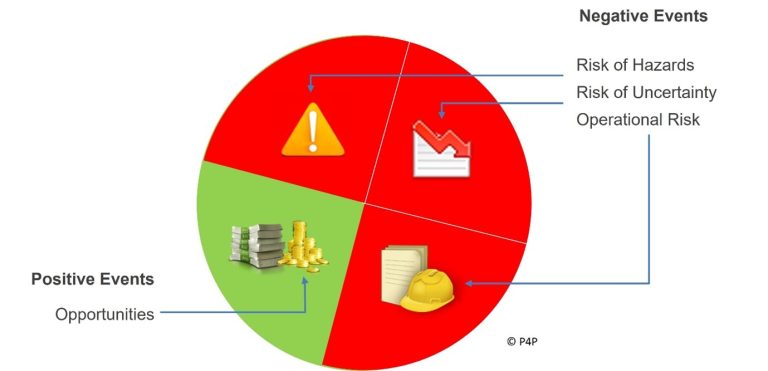
A Risk is the chance, high, medium, or low, that someone could be harmed by a hazard.
Risk Management is the identification, evaluation, and prioritisation of risk to prevent a risk event that can result in injuries or illness to a person or the possibility of losing something of value including, financial assets and social status.
Risks events can be any occurrence or situation that can come from various sources among other things, uncertainty in financial markets, legal liabilities, accidents, natural causes and disasters, deliberate attacks from opposition, project failures, fire, flood or failing to act on an opportunity.
Risks events may be classified into four main categories:
- Risk of Hazards
- Risk of Uncertainty
- Operational Risk
- Oportunities
Risk of Hazards
The risk of hazards is often caused by improper or poor workplace safety that present a danger to people or cause severe damage to equipment and or property.
Electrical Accidents
- Unprotected exposure to high voltage electrical outlets
- Un-insulated, un-isolated or poor wiring
- Broken circuits
- Faulty extension cables
- Unsafe equipment or installation
- Lack of personal protective equipment (PPE)
- Lack of training
All of which can result in a fire, electrical burns, electric shock, cardiac arrest or even death by electrocution.
Once you’ve established any new or amended rules that are applicable to your industry, the next step is to determine how these regulatory changes may affect your organisation.
To assess the impact, consider:
- What products, services, or business activities will be affected
- Which systems have connections to the affected products and services
- If your company will need new policies or make changes to current ones
- If your company will need new procedures or amend current ones
- Any other current policies or procedures, that might be impacted and may need to be adjusted to ensure complete compliance.
- Any other dependencies such as a specific department, or supplier that the changes could affect
Your Legal Obligation
As a business, you’re required by law to protect your employees, and others, from harm under the Management of Health and Safety at Work Regulations 1999
The law applies to you if:
- You are an employer
- Your work activity is specifically mentioned in the regulations, such as construction, agriculture, railways, gas or asbestos
- Your work activity poses a risk to the health and safety of anyone else
